
Our
Methods
Our synthesis work centers on creating solid-state organic compounds that absorb and release CO₂ at low temperatures. The compounds we create are designed for efficient, reversible CO₂ binding to enable low-energy cycling.
To increase working capture capacity and further reduce energy demand, we integrate our materials into porous frameworks to maximize surface area and CO₂ uptake. These approaches help us refine how the material interacts with CO₂ and identify structures that maximize adsorption and desorption performance.

Once a material demonstrates strong performance in the lab, our implementation work focuses on translating those results into practical systems. This includes developing matrices and support structures that enhance airflow, heat management, and contact efficiency; evaluating how materials integrate into larger sorbent beds; and designing pathways for scale-up and modular deployment. Implementation bridges fundamental chemistry with real-world engineering—ensuring our materials are not only effective but also manufacturable, durable, and economically viable.
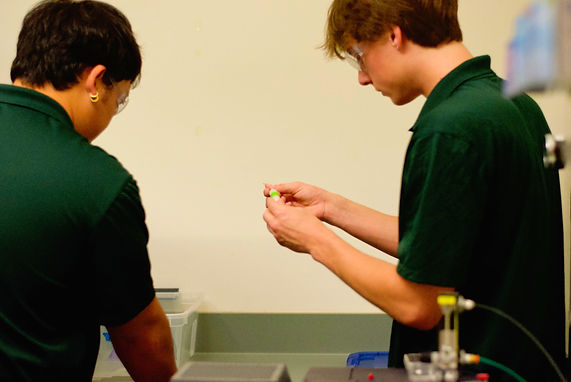
To understand how these solid-state materials behave under realistic operating conditions, we have developed a specialized testing apparatus that evaluates the effects of humidity, temperature, and carbon dioxide concentration. The system integrates nondispersive infrared (NDIR) gas analysis to track changes in gas composition, providing precise, real-time measurements of CO₂ uptake and release.
All materials are tested in a packed-bed column configuration, an industry-relevant format that allows us to quantify kinetics, capacity, and stability. This testing platform enables rapid iteration and helps identify the optimal conditions and material structures for efficient, scalable carbon capture.
